
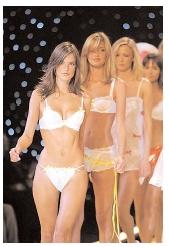
"If media caused eating disorders, I think half the country would have a diagnosable eating disorder."
http://www.raderprograms.com/causes-statistics/media-eating-disorders.html
Body Image
- Often, one of the first seating disorders symptoms to manifest is poor body image.
- According to a study from the University of Central Florida, nearly 50% of girls aged three to six were already concerned about their weight.
- A study showed that women experience an average of 13 negative thoughts about their body each day, while 97% of women admit to having at least one “I hate my body” moment each day.
- Roughly half of the women in the U.S. wear size 14 or larger though most standard clothing retailers only cater to sizes 14 and smaller.
- When asked to choose their ideal body shapes, 30% of women chose one that is 20% underweight while 44% chose an ideal body shape that is 10% underweight.
- A Glamour magazine survey showed that 61% of respondents felt ashamed of their hips, 64% felt embarrassed by their stomachs, while 72% were ashamed of their thighs.
- One study showed that women overestimate the size of their waists by 25% and hips by 16%, while those same women could correctly estimate a box’s width.
- One study showed that 75% of women consider themselves overweight when, in reality, only 25% were.
- Four out of five women in the U.S. are unhappy with their appearance.
- 81% of ten-year-old girls experience a fear of being fat.
- 42% of 1st through 3rd grade girls say they wish they were thinner.
- Adolescent girls are more afraid of gaining weight than getting cancer, losing their parents or nuclear war.
- More than half of white, adolescent girls who are a normal weight view themselves as fat.
- Seven out of ten women felt angrier and more depressed following the viewing of fashion model images.
- A study that offered preschoolers a choice between two dolls that were identical except for weight, the preschoolers chose the thinner doll nine out of ten times.
- Children were asked in one study to rate pictures of other children based on attractiveness. The obese child was rated less attractive than a child with a facial deformity, a child in a wheelchair and a child who is missing a limb.
“We turn skeletons into goddesses and look to them as if they might teach us how not to need.”
― Marya Hornbacher, Wasted: A Memoir of Anorexia and Bulimia
― Marya Hornbacher, Wasted: A Memoir of Anorexia and Bulimia
“Some people who are obsessed with food become gourmet chefs. Others become eating disorders.”
― Marya Hornbacher, Wasted: A Memoir of Anorexia and Bulimia
― Marya Hornbacher, Wasted: A Memoir of Anorexia and Bulimia
“To live in a culture in which women are routinely naked where men aren't is to learn inequality in little ways all day long. So even if we agree that sexual imagery is in fact a language, it is clearly one that is already heavily edited to protect men's sexual--and hence social--confidence while undermining that of women.”
― Naomi Wolf, The Beauty Myth
― Naomi Wolf, The Beauty Myth
“The last thing the consumer index wants men and women to do is to figure out how to love one another: The $1.5 trillion retail-sales industry depends on sexual estrangement between men and women, and is fueled by sexual dissatisfaction. Ads do not sell sex--that would be counterproductive, if it meant that heterosexual women and men turned to one another and were gratified. What they sell is sexual discontent.”
― Naomi Wolf, The Beauty Myth: How Images of Beauty are Used Against Women
― Naomi Wolf, The Beauty Myth: How Images of Beauty are Used Against Women

No comments:
Post a Comment